
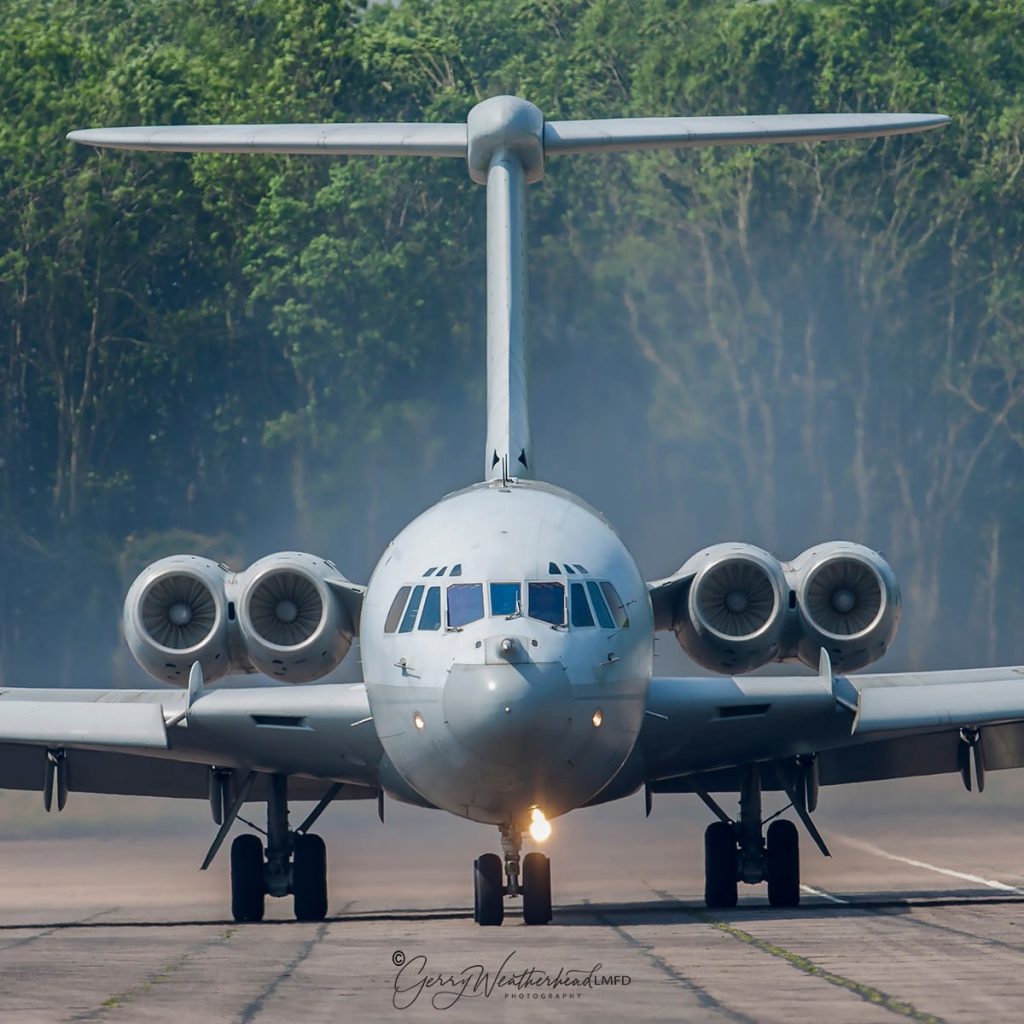
Throughout the early 2000s, I was a photographer connected with a group of aviation enthusiasts who kept a large collection of aircraft at an East Midlands airfield. The collection included a Nimrod, a Canberra, a couple of Lightnings, several Blackburn Buccaneers, a Victor and an iconic VC-10.
Most, if not all, of these airframes were in flying condition, although they were limited by the CAA to performing fast taxi runs along the long runway during open days throughout the year.
As an airside photographer, I was able to get up close and personal with these aircraft and choose the best angles to capture them during their runs. On this particular day, I decided I wanted to photograph the VC-10 head-on as it began its fast taxi run.
Despite its huge size, its four tail-mounted Conway jet engines produced a surprising amount of thrust, capable of propelling the aircraft from stationary to maximum taxi speed far more quickly than I had anticipated.
I picked out a spot on the runway which I called my “move-out-of-the-way point”. In other words, once the VC-10 reached that point, it would be wise for me to move sharply to the side of the runway as the aircraft passed at speed—or at least, that was the theory.
Before attempting this, I cleared it with both the airfield authorities and the VC-10’s pilot. They agreed that as long as I moved in time, the decision was mine, and they were happy for me to attempt this slightly risky manoeuvre to capture the head-on shot.
As the aircraft was about 600 yards away, it was the movement of the trees behind it and the rising roar of those four Conway engines winding up that alerted me that the fast taxi run had begun.
I kept the camera pressed to my eye while watching for the aircraft to reach my chosen “move-out-of-the-way point”. However, when it reached that mark, I took one or two more photos than I had planned. Those extra seconds allowed the aircraft to get much closer than I was comfortable with.
When I finally lowered the camera, I could clearly see the pilot’s face at the controls. That was the moment I realised I had left it a little late.
I immediately took several large strides to my right towards the edge of the runway and to this day, I believe that if I had waited even one second longer before moving, you probably wouldn’t be reading this.
That was far closer than I ever intended.